Followers

Showing posts with label military. Show all posts

Sunday, May 15, 2022

Vintage Military - Part 25

WWII - Tarawa, Kwajalein

After capturing the Solomon Islands near New Guinea, the next step in Admiral Nimitz' island-hopping campaign against Japan was to take the Gilbert and Marshall Islands in the central Pacific. 

The main battle in the Gilbert Islands was on the atoll of Tarawa in November, 1943.  The video above shows supplies being landed on a neighboring atoll.  Note that some of the workers are wearing clothes that are getting soaked, while others are more sensibly working naked.

LIFE photographer John Florea took this photo of a base on Tarawa.  From all of the clothing lying around on benches, it appears that the men are washing.

And here's a closeup by Florea of a man bathing in what looks like half of an oil drum.

The next step was the capture of Kwajalein atoll in the Marshall Islands on Jan. 31 - Feb. 3, 1944.  This uncredited photo shows Marines enjoying the beach on Kwajalein after the battle.

An improvised shower on Kwajalein.

MPs of the 7th infantry division watch Japanese POWs on Kwajalein.

LIFE photographer George Strock took this photo of captured Japanese soldiers.

An unattributed photo of captured Japanese soldiers on Kwajalein.  Captured Japanese were made to strip naked to make sure they were not carrying any weapons.

Saturday, April 23, 2022

Vintage Military - Part 24

WWII - Australian Troops in New Guinea

We've previously seen American troops in New Guinea in World War II, photographed by LIFE magazine war photographers.  But the Allied offensive in New Guinea was a joint effort of American and Australian troops.  Here are some photos from the Australian War Memorial photo archive.

Above: Australian troops sharing an outdoor shower in Port Moresby, New Guinea in 1942.  Port Moresby, on the south shore of New Guinea, was held by Australia before the war, and the Japanese effort to capture it failed.  As the only port serving Allied operations in New Guinea, it was critical to the campaign.

Troops in Port Moresby relaxing in a stream after a march in 1942.  Of course they're swimming naked, because that's what soldiers did in those days.

Troops bathing in the Basari River in Soputa, New Guinea in 1942. 

Another photo of troops bathing in the Basari River in Soputa.

Somehow an American got into the Australian War Memorial photo archive.  This is Private Sal Corona from California swimming In a bomb crater in Buna, New Guinea on Jan. 8, 1943.  The photo is by LIFE photographer George Silk, but it's in the Australian War Memorial archive, not the LIFE photo archive.

Sergeant Ron Nation washing and bathing on Goodenough Island, an island off New Guinea, in June 1943.  The Australian War Memorial site lists the names of the men in these photos, which are now publicly available on the Internet, even when the photos show frontal nudity.  As I've said before, there's no privacy in the Army!

M.C. Curnow (left) & M. McPhail (right) on a tire In a stream in Tsili Tsili, New Guinea, November 1943.

Donadabu, New Guinea, Nov. 9, 1943  Troops of 7th Australian infantry brigade hold an impromptu swimming carnival in the Laloki River.  Lieutenant L. Hatton is standing at left. 

We end with RAAF pilot W.O.K. Hewett shaving in a stream in the Buna area in 1943.  New Guinea is almost on the Equator, and it gets hot.  Who needs clothes?

Thursday, March 31, 2022

Vintage Military - Part 23

 WWII - Italy

After the Allies took Sicily, Italian Fascist dictator Benito Mussolini was deposed.  A new government signed an armistice with the Allies, but Hitler was unwilling to give up Italy so easily.  German forces took over Italy and Mussolini was put in charge of a puppet state, actually controlled by Germany.   German soldiers fought in Italy against the British Eighth Army under General Montgomery and the American Fifth Army under General Mark Clark.  The operation to retake Italy lasted from Sept. 1943 to April 1945, moving from south to north.

The caption of the December 1943 British photo above says: "Sapper B. Rainey of 1 Whalley Rd, Northwich, Cheshire enjoys a most welcome shower bath."  This and today's other British photos are from the Imperial War Museum collection, which often gives the names of soldiers in the photos, and in this case, it even gave his home address.  Well, there's no privacy in the Army!

This photo of American soldiers stripping to shower is from a set called "Air Artillery, Italy" in the LIFE photo archive.  It was taken in February 1944 by Margaret Bourke-White, who was a rare female war photographer.

March, 1944.  To bypass heavily defended German fortifications, the Allies staged a beach landing at Anzio, which in a way was a practice run for the D-Day invasion of France a few months later.  These are soldiers of the British Fifth Army at Anzio.  Caption: "Water supply at Anzio.  A batch of infantrymen back from the front line take a shower."

June, 1944.  British troops find more civilized shower facilities in the Royal Palace in Naples.  Caption: "Private Smith takes a shower in the shower baths available to visiting troops."  Although I doubt that these shower stalls would have been used by royalty, they are made of marble.  Perhaps they were built for the servants.

June, 1944.  American troops, one of them stark naked, heading across a lake in a rubber boat.  Photo by LIFE photographer Carl Mydans.

June, 1944.  Caption: "Three British soldiers take advantage of a rest from the line and cleanse themselves in Lake Trasieno. The far end of the lake is still in German hands."

October, 1944.  Caption: "At a front line bath unit, well within range of enemy shellfire, men of the 16-5 Lancers take advantage of a break in the weather to rid themselves of some of the accumulated mud of Italy."

October, 1944.  Caption: "Trooper D.H. Ireland of Hounslow, Middlesex, enjoys his newspaper as he lies soaking in a mountain stream."

In April 1945, Mussolini was captured and executed by the Italian resistance.  This photo from April 28, 1945 shows his naked corpse.  Mussolini's Fascist dream was to recreate the empire of ancient Rome by conquering the countries around the Mediterranean.   Perhaps this should be a warning to other dictators who seek to recreate vanished empires by conquering neighboring countries.

Thursday, March 10, 2022

Vintage Military - Part 22

 World War II - Mareth Line, North Africa

In March, 1943, as the British Eighth Army drove Rommel's Afrika Korps westward across the desert, the Germans and Italians made a stand at the Mareth Line, a line of fortifications built by the French in the 1930s to defend Tunisia.

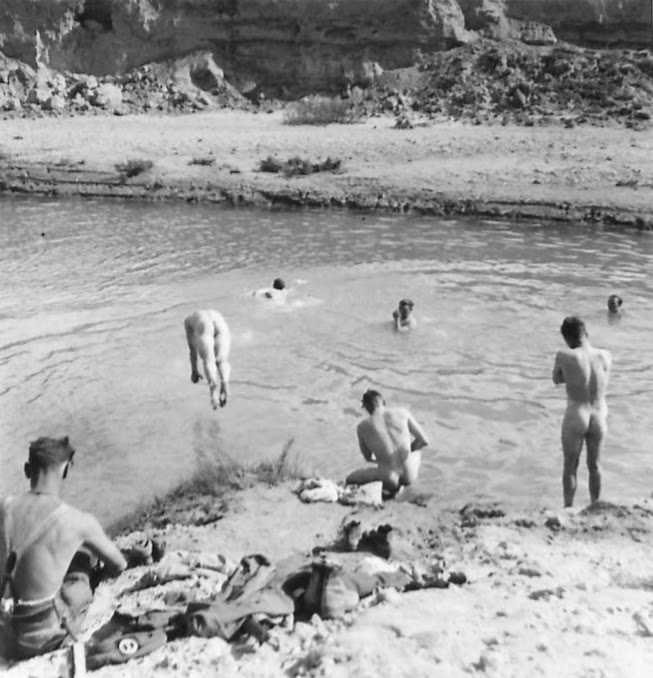
Today's photos are from Britain's Imperial War Museum.  This one, dated March 20, 1943, is labeled "Seaforth Highlanders take advantage of the recent rains and swim in the flooded Wadi Zessar near the Mareth Line.  They originally took part in the battle to effect a crossing of this Wadi." 

This photo has the same date and caption as the previous one.  The men are swimming naked because that's what soldiers did in wartime.

The remaining photos are dated five days later, March 25, 1943, in a set called "With a Highland Division in the Mareth Area."  This photo is labeled "A party of Jocks make a dash for the showers.  51st Highland Division."

"Jocks" does not mean they were athletes.  Scottish soldiers were called Jocks (Jock being a common Scottish nickname, corresponding to Jack), just like English soldiers were called Tommies in World War I.

This photo is labeled "Communal method of back drying.  The men line up and assist each other."

This one is labeled "Cooling off after a spell in the line."  Note the Scottish tam o'shanter hat.

Finally, we have "Hot showers provided for the men in the front line."

The British were able to outflank the Germans and Italians by going around the Mareth Line through desert country that the French who built the Mareth Line had thought was impassable for motor vehicles.  By March 27, German resistance was broken, and the Germans and Italians retreated.  They were ultimately surrounded by combined British and American forces in Tunisia and surrendered on May 13, 1943.

Thursday, February 17, 2022

Vintage Military - Part 21

World War II - Finland 1943

Finland continued to fight the invasion by the Soviet Union.  All these photos are from the amazing Finnish World War II photo archive SA-Kuva.

We start at the military academy in Santahamina, Helsinki, where a naked cadet is diving into the indoor pool in March, 1943 while some officers look on.

Two soldiers on a dock in Anttonala in June, 1943.  Finland is the land of lakes – over 180,000 of them.

A soldier with a telephone.  The way the phone is lying there makes me wonder whether he's waiting for an operator, perhaps to connect long-distance, which in those days was a manual process that could take a long time, or whether the strange, boxy phone simply has no way to hang up.

Cavalry recruits training at Ihala in July, 1943.  No sense wearing clothes if you and the horse are going to get wet.

Another cavalry recruit at Ihala.  I've cropped the photo, which I've posted previously, for a better view.

A whole bunch of recruits on the dock at Ihala.

Some soldiers relaxing and swimming at Mökerikkö in September, 1943.

Weighing in for an Army boxing and wrestling match at Viipuri in February, 1943.

A soldier in the sauna at the Army boxing and wrestling match at Viipuri.  This may be my favorite photo from the entire SA-Kuva archive of 160,000 photos.  The original was a bit overexposed, so I adjusted the brightness and contrast.  This guy is so hot, he is literally steaming!

It wouldn't be Finland without the sauna.  We end where we began, at the military academy in Santahamina, in October, 1943.  These guys look too old to be cadets, so they must be teachers, with the possible exception of the third guy who has arranged his legs to give us a better view.

Friday, January 28, 2022

Vintage Military - Part 20

World War II - Sicily

After the Allied reconquest of North Africa, the next step was to begin the recapture of Europe from the Nazis and Fascists.  The opening move was Operation Husky, the invasion of Sicily from North Africa.

The video above, from Britain's Imperial War Museum, shows troops swimming from the ships that had gathered in the harbor at Sfax, Tunisia.  The video was taken on July 6, 1943, a few days before the invasion.  A couple of the troops had swimsuits, but the vast majority swam naked.  In wartime in those days, it was not a big deal.

American, British and Canadian troops landed on the night of July 9th, 1943 and quickly defeated the Italian resistance.  Above, Italian prisoners, some naked, on the beach.

(Photo by LIFE photographer Bob Landry, cropped to show detail)

This is why some of the Italian prisoners were naked.  They had to wade out to board a landing craft, presumably taking them to a POW camp.

(Photo by LIFE photographer Bob Landry)

I used this photo in a previous post about Australian photographer Laurence Le Guay.  Members of an Australian Royal Air Force fighter bomber squadron had provided air support for the invasion.  Here they are afterwards in Sicily enjoying a bucket shower.

Showers were in short supply in wartime, and the troops took every opportunity to shower that they could get.  This short clip from a newsreel shows an Operation Husky soldier taking an improvised shower.

Finally, this footage was taken for a British Pathé newsreel but was unused or not released.  It shows Canadian troops in Sicily taking advantage of another improvised shower opportunity, using water dripping from a railroad water tower.

Saturday, January 8, 2022

Vintage Military - Part 19

World War II - Lae, New Guinea

We last saw the action in New Guinea at the battle of Buna in January, 1943.  General MacArthur's forces continued moving west to retake the Japanese-occupied north coast of New Guinea.  

In September 1943, the 9th Australian division under General Wooten landed just east of Lae, a Japanese stronghold.  Meanwhile, an American parachute regiment made a drop and secured an airfield west of Lae, allowing the Australian 7th division, under General Vasey, to fly in.  The two generals bet twenty cases of whiskey on who would reach Lae first.  Vasey won.

These photos were all taken by LIFE photographer Myron Davis, who was accompanying the troops.  The photo above, showing troops bathing in a river, has been cropped and brightened to show detail.

This photo, dated October 1943, is from a series called "Occupation of Lae."  We see more troops bathing in a river.

Here we see troops marching across what looks like a newly-constructed bridge, not to mention a soldier bathing in the river.

Note: I'm guessing that the bridge piers were designed by someone who played with Lincoln Logs as a child.  Lincoln Logs were invented by the son of architect Frank Lloyd Wright in 1916, and American soldiers in World War II would certainly have been familiar with them. 

Two more men in the river, and two others appear to be trying to swim, but the water is only ankle-deep.  Maybe they're just cooling off.  New Guinea is almost on the Equator, and it's warm year-round.

This photo by Myron Davis of troops showering is from a series called "Troop Carrier Planes" from December, 1943.  I don't think it's from New Guinea.  By that time, Davis was with troops on islands offshore of New Guinea preparing for the invasion of the island of New Britain.

We end with a cropped version of a photo I previously posted, showing 24-year-old photographer Myron Davis in December, 1943, naked and swinging from a vine on one of those islands prior to the invasion of New Britain.