Followers

Sunday, March 14, 2021

Photographers - Part 4

 John Dugdale

John Dugdale was born in 1960 and is still alive.  What is fascinating is that his best work was done after he went blind.  How is that possible?  Read on.

He embarked on a successful career in commercial photography, photographing things like cashmere and china and glassware, which was lucrative but not soul-satisfying.  In his few non-commercial photos, he often featured male nudes, like Joao II Sitting, 1991 (above).  For Dugdale, a revealing photo meant ridding the self of clothes.  “Life is transient,” he said.  "Once you leave this world, you fly into the universe without clothes. I want people to learn you cannot protect yourself by hiding behind clothes.”

He bought a house in rural update New York, which became his retreat.  His obsession was to restore it to its original 19th century state, a time period that he loves.   Maurice Sendak, the children's book author, became Dugdale's friend and a father-figure to him.  Sendak collected his photos, including this one from 1993, Kneeling male nude and seated woman, now in the Metropolitan Museum collection in New York.  It is one of a series featuring a naked man along with clothed men and women dressed in Victorian costumes – which of course would never have happened, so these photos are fantasies, but they are in tune with Dugdale's love of the 19th century.

Dugdale is gay.  Sometime in the 1980s he contracted HIV.  In 1993 he became completely blind in his right eye and lost 80% of the vision in his left eye due to an HIV-related disease.  He also suffered a series of strokes that left him paralyzed, and he was hospitalized for a year.  New AIDS drugs came out just in time, and he survived, but his life was changed.

He taught himself to walk again and decided to switch to art photography, exploring 19th century techniques and using an antique large-format camera.  He also switched his development process to cyanotype and platinum prints, particularly because he hated the toxic chemicals from his AIDS treatments, and cyanotype (the process used for blueprints) uses only non-toxic chemicals (iron salts).  

His vintage full-format camera has a huge 11x14-inch ground glass viewfinder at the back.  He was still able to see enough of the image to work, though he had to ask an assistant to focus the image to make sure it was sharp.  Later, as his remaining sight disappeared, he asked the assistant to move his (Dugdale’s) finger on the viewfinder screen to trace the outlines of the photo subjects, and in that way he could still “see” the subjects and tell them to move until the image was what he wanted. Above is a cyanotype called A Turbulent Dream, 1996.  More often than not, his subjects were male nudes, and often he  himself was the model.

I Could Not See to See, 1994 (above) is a platinum print, made using another vintage process.  The title comes from a poem I heard a Fly buzz by Emily Dickenson.  Dugdale told the story behind this photo:

So this fellow came over, beautiful, sculptural body, just what you would want for a photograph. … I took a number of pictures of him, and he was kind of blank and I was kind of blank, and I can tell these are just going to look like art porn pictures, which I never let go out of here…. I said, "Listen I don't even know you but I've got this long shutter release, could I come and sit in between your legs?”

So, we—he opened up his legs and I got in between, and put my back against his chest, and he put his arms around me. I put my head down, he put his head down on my neck, and I snapped the picture. That was the one piece of film that I had left, that I call I Could Not See to See.


And what I learned on that day, is that I had to rethink my idea about intimacy.

Sun God, 1997 (above) also has a fascinating story.  Dugdale was scheduled to speak at the University of Alabama.  He took this photo of his model Ivan and he thought "You know what, this is my David [referring to Michaelangelo's David], I'm going to put this in the slide carousel and bring it down to Alabama, and I'm going to show it during the talk where there was faculty and students.”  He went to Alabama to give his talk.  He described what happened:

Everything's pretty safe, then kaboom!, you know nine feet tall, this picture way in your face, but inarguably a beautiful classical figure study. There was nothing but silence and I thought, "Oh gosh, okay." There's mostly silence, I can really listen to the audience and hear murmurs, inhalations, exhalation. I can feel them leaning forward or leaning back. I can tell when they're getting restless, when they're feeling emotional. It's incredible, the energy that I can feel from people while we're experiencing the journey that I'm telling you about photographically.

And so it's all silence during Ivan's picture, and I was out in town the next day walking around and you know what? People kept approaching me, "Can I take you aside for a minute?" "Do you have any idea how grateful I am that you showed that picture yesterday?" "We don't get to see stuff like that, in that room very often; we're so thrilled." Teachers, women, men teachers, young men, young women, all races, and I thought, "Oh you know what, I did the right thing." You know, it was so nice to bring that to them. And I also thought I should get off the street in case anyone was going to take a pot shot at me with a gun. You know I felt very uncomfortable, but I guess it was all a bit of activism on my part.

This is In the shadow of his beloved, 2000.  Dugdale is a master of double exposures.  Here the standing figure is ghostly – you can see through him – but you can't see through the seated figure (who I think is Dugdale himself; many of his photos are self-portraits).

Finally, this is Smile, for your lover comes, 2000.  One is tempted to feel sorry for Dugdale because he's blind, but Dugdale is not sorry for himself.  Going blind forced him to give up an unsatisfying commercial career, and it made him concentrate on what he loves.  "The mind is the essence of your sight," he says.  "It's really the mind that sees."

Saturday, March 13, 2021

Ads - Part 1

 Vintage Ads

Advertisers know that sex sells.  So, they sometimes feature nude or nearly nude models or artwork in their ads.  As in every other aspect of life, nude women have been featured far more often than men, presumably because men were designing the ads.  But some advertisers were canny enough to realize that the primary targets of their ads were women, and to design the ads accordingly.  We start with some vintage examples.

This 1917 ad for Ivory Soap presents just a misty, teasing view of some guys taking showers.

In this 1918 Ivory Soap ad in National Geographic, the nude guy is clear and prominent, but in a non-revealing pose.  This is a patriotic World War I ad about how Ivory Soap is helping"our boys" at the front.


Another 1918 patriotic World War I ad in National Geographic tells how Hercules Powder Company is helping to win the war.

A patriotic ad from World War II.  This 1943 ad tells how the soldiers are using Cannon towels.  And the art manages to show a little bare butt.

This is a 1947 ad In Walkabout, a magazine that was the Australian equivalent of National Geographic.  Apparently the Victorian Government Tourist Bureau thought that people could be enticed to visit Central and Northern Australia in order to see naked Aborigines.

We close with this 1948 ad for Seagram's 7 Crown whiskey, published in LIFE magazine.  It doesn't feature any nude bodies, but the rock formations are noteworthy.  The "7 crown" rock formation is fake, of course, but the arch on the left is real – Delicate Arch in Arches National Park (in 1948, it was Arches National Monument).  Delicate Arch is actually not on flat ground like this picture.  It's only reachable by a cliffside trail (I've been there).  That's OK; this scene is an "artist's conception."

Now notice the rock formation to the right of the "7" rock.  It's clearly a giant penis.  Is there such a rock in Arches National Park?  Yes, there is.  It's 100 feet tall, called the Phallus.  But, like Delicate Arch, it's not located near any of the other rock formations shown.  Again, this is an artist's conception, not a real landscape.

The artist, given the task of producing the painting for this ad, decided to include the well-known Delicate Arch, and then he (I'm guessing it was a male artist) snuck in the giant penis, possibly as a joke.  Well, he was asked to illustrate a "natural wonder."

I have many more nude ads that I'll show you in future posts.

Friday, March 12, 2021

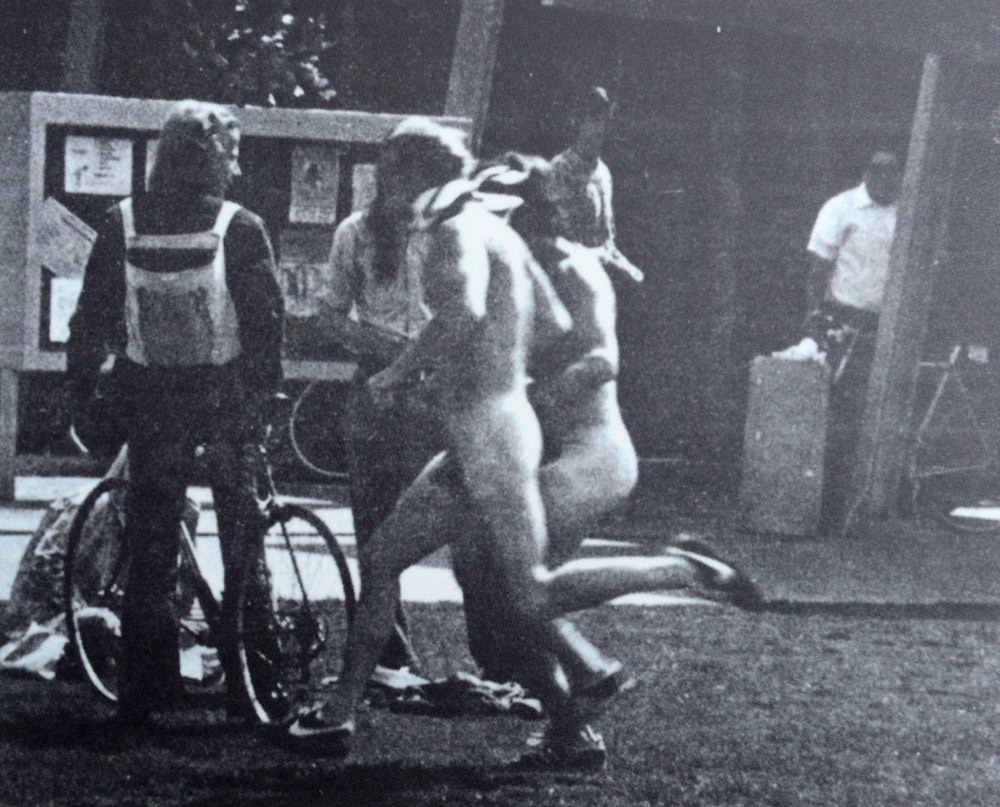
College Streaking - Part 6

 California

More college streakers participating in the nationwide streaking fad in the spring of 1974.  These are all California colleges.

University of California, Irvine

University of California, Irvine

Orange Coast College

Santa Clara University (from the 1974 yearbook The Redwood)

University of California, Berkeley,  This and the following two photos were taken by Ron Riesterer.

University of California, Berkeley

University of California, Berkeley

Whittier College (from the 1974 yearbook Acropolis)

Glendale Community College, March 1974

Thursday, March 11, 2021

Performers - Part 2

The Full Monty

The 1997 movie "The Full Monty" was delightful, and it had more depth than its strip show plot might suggest.  But I have to say, the finale of the strip show (above) was a disappointment, because the actors show "the full monty" to their audience, but not to us – we only see a rear view.

But various groups have subsequently put on a number of "Full Monty" strip show performances.  This is the finale of one of the best I've seen.  It's called "Jo Burt's Full Monty Charity Night."  You can tell the performers are amateurs, not Chippendale types, which adds to the charm.  And we get to see the full monty.

Wednesday, March 10, 2021

Vintage Military - Part 5

 World War I - Les Poilus

In World War I, the French gave their soldiers the nickname "poilu" (pronounced pwah-loo*), meaning "hairy one."  The soldiers were called poilus whether they were actually hairy or not.  It was an affectionate term, like the British soldiers being called "Tommies" and the American soldiers "doughboys".  Here are some photos of World War I "hairy ones".  All are from a French website, and all are dated 1914-1918.

* Apology to my French viewers: "pwah-loo" is the closest that I can get in English to how "poilu" is pronounced because the French "u" sound doesn't exist in English.

This is a French postcard labeled "The bath of the poilus."  Note that most, if not all, of these men taking tub baths have mustaches, one possible origin of the term "poilu".  More about mustaches below.

This photo is titled "The ingenuity of our poilus - the shower," showing a shower improvised out of a watering can.

This photo was called "Poilus off-duty.  Sport fest at Courmelois, near Reims."

This one was labeled "Poilus at the showers in the 3rd line behind Thuisy near Courmelois."

These are poilus in a German POW camp.

This one says "A shell hole, rainwater, voila, totally comfortable for washing."

Our last photo was labeled "8th infantry regiment soldier cul nu (bare ass)."  Under the photo was written "Bored photographer, July 1, 1915."

Some sources claim the term "poilu" (hairy one) referred to the soldiers' mustaches.  In France, in the 1800s and up to World War I, mustaches were not only fashionable, they were a mark of prestige and authority.  Servants and cafe waiters were forbidden by law to have mustaches, because of their inferior status – waiters were not called garçons (boys) for nothing.  In 1907 the waiters actually went on strike in Paris for the right to have mustaches (they won).

I found some fascinating information on a Belgian website (and remember that much of World War I was fought in Belgium).  It said that when America entered the war in 1917, hundreds of thousands of American soldiers suddenly arrived.  The U.S. Army required them to be clean-shaven.  The Americans were bigger than the Europeans on average (better fed?).  The site relates how in southern Belgium, the girls were attracted to these fresh, big, clean-shaven young hunks.  Suddenly, the mustache went out of style, and the European soldiers shaved their mustaches off.

Tuesday, March 9, 2021

WNBR - Part 4b

 Locations in the U.S.

More World Naked Bike Ride locations across this great country.

Montpelier, Vermont, 2008

New Orleans, Louisiana, 2017

New York, New York, 2009

Philadelphia, Pennsylvania, 2015

Portland, Oregon, 2012


San Francisco, California, 2010

Seattle, Washington, 2012

St. Louis, Missouri, 2019

We end with Washington DC, 2009.  In some cities, police are more strict about anti-nudity laws, and WNBR riders have to cover up, like this guy with a sock.  Official WNBR policy doesn't require riders to be nude.  It just asks them to be "as bare as you dare."

Monday, March 8, 2021

WNBR - Part 4a

 Locations in the U.S.

Cities all across the U.S. have hosted World Naked Bike Ride events.  Here are some:

Austin, Texas, 2016

Bellingham, Washington, 2017

Berkeley, California, 2009

Boston, Massachusetts, 2014

Chicago, Illinois, 2013

Eugene, Oregon, 2009.  A rider promoting the message for drivers to be more careful.

Madison, Wisconsin, 2016.

Los Angeles, California, 2012.  One rider checking out another.

Tomorrow: more WNBR locations in the U.S.